
Reflections from the EMA Annex 22 Workshop
The EMA Quality Working Party Workshop on the draft Annex 22 – Artificial Intelligence (30 June) gave industry representatives the opportunity to discuss one of the most debated topics in the draft guideline: the use of generative AI and other probabilistic AI/ML models in GMP.
Since the publication of the draft Annex 22 last year, industry has submitted more than 1,300 comments. The strongest feedback focused on the proposed restrictions on dynamic and probabilistic models in critical GMP applications.
To address these concerns, the EMA invited industry associations to provide consolidated positions on six key topics. Much of the discussion focused on how appropriate guardrails can enable the safe use of modern AI technologies while maintaining patient safety and regulatory compliance.
I had the opportunity to contribute to two of these topics on behalf of the PDA. Over approximately two months, experts from across the industry collaborated to develop consistent recommendations—not only within each topic but also across the workshop as a whole.
Several common principles emerged:
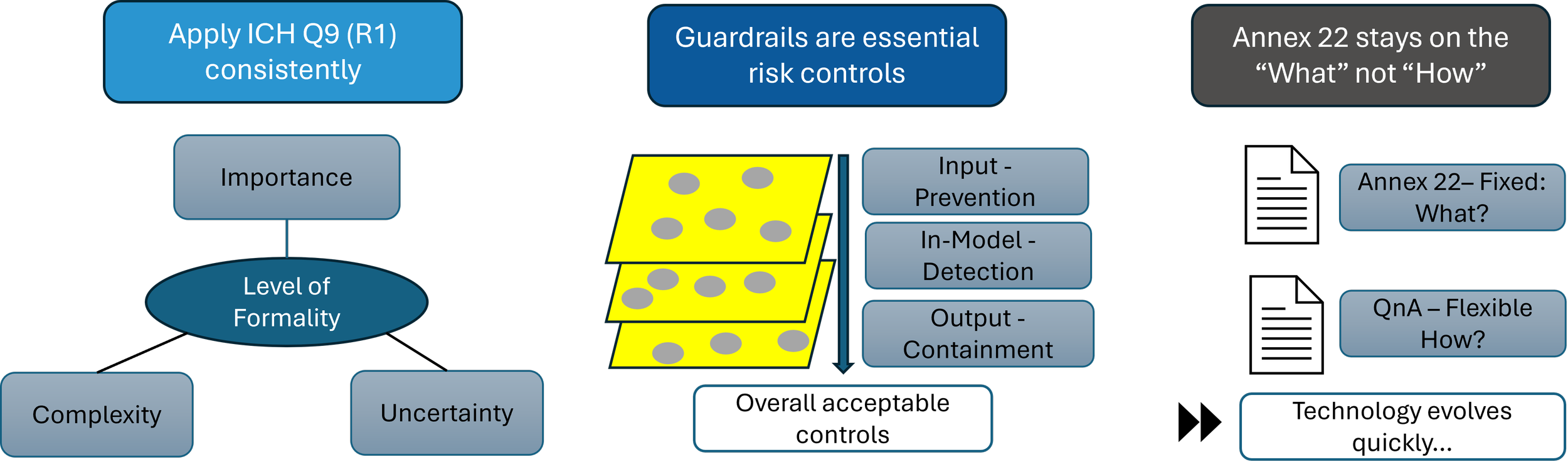
Summary of the most relevant points.
Apply ICH Q9(R1) consistently. Quality Risk Management is technology-agnostic. The concept of scaling the level of formality based on importance, uncertainty, and complexity provides a strong framework for determining whether an AI solution is suitable for GMP use and what level of oversight is required.
Guardrails are essential risk controls. They can significantly reduce uncertainty and improve confidence in AI outputs. A layered approach proved particularly compelling:
Input guardrails – Prevention
In-model guardrails – Detection
Output guardrails – Containment
Together, these layers form a robust defense, comparable to the well-known Swiss Cheese Model.
Annex 22 should focus on the "what," not the "how." Industry strongly recommended that the guideline define regulatory expectations without prescribing specific technical implementations. Given the rapid pace of AI innovation, technical details are better maintained in more flexible documents such as Questions & Answers or guidance papers.
Over the coming weeks, I'll publish a series of articles exploring these topics in more detail, including Quality Risk Management, guardrails, human oversight, and practical implementation strategies for AI in GMP.
Stay tuned and sign up for more content here.
