
Audit trails and their reviews remain among the most frequently discussed—and often most resource-intensive—elements of Data Integrity programs. Yet, deficiencies continue to appear in FDA Warning Letters and Form 483 observations.
Why is this still such a challenge?
The FDA defines an audit trail as “a secure, computer-generated, time-stamped electronic record that allows for reconstruction of the course of events relating to the creation, modification, or deletion of an electronic record.” [1]
In simpler terms, an audit trail should tell us who did what, when, and why.
Despite years of regulatory guidance, audit trails and their reviews continue to feature prominently in FDA inspection findings. Recent observations reveal four recurring weaknesses, ranging from missing technical functionality to inadequate review strategies and failures in execution.
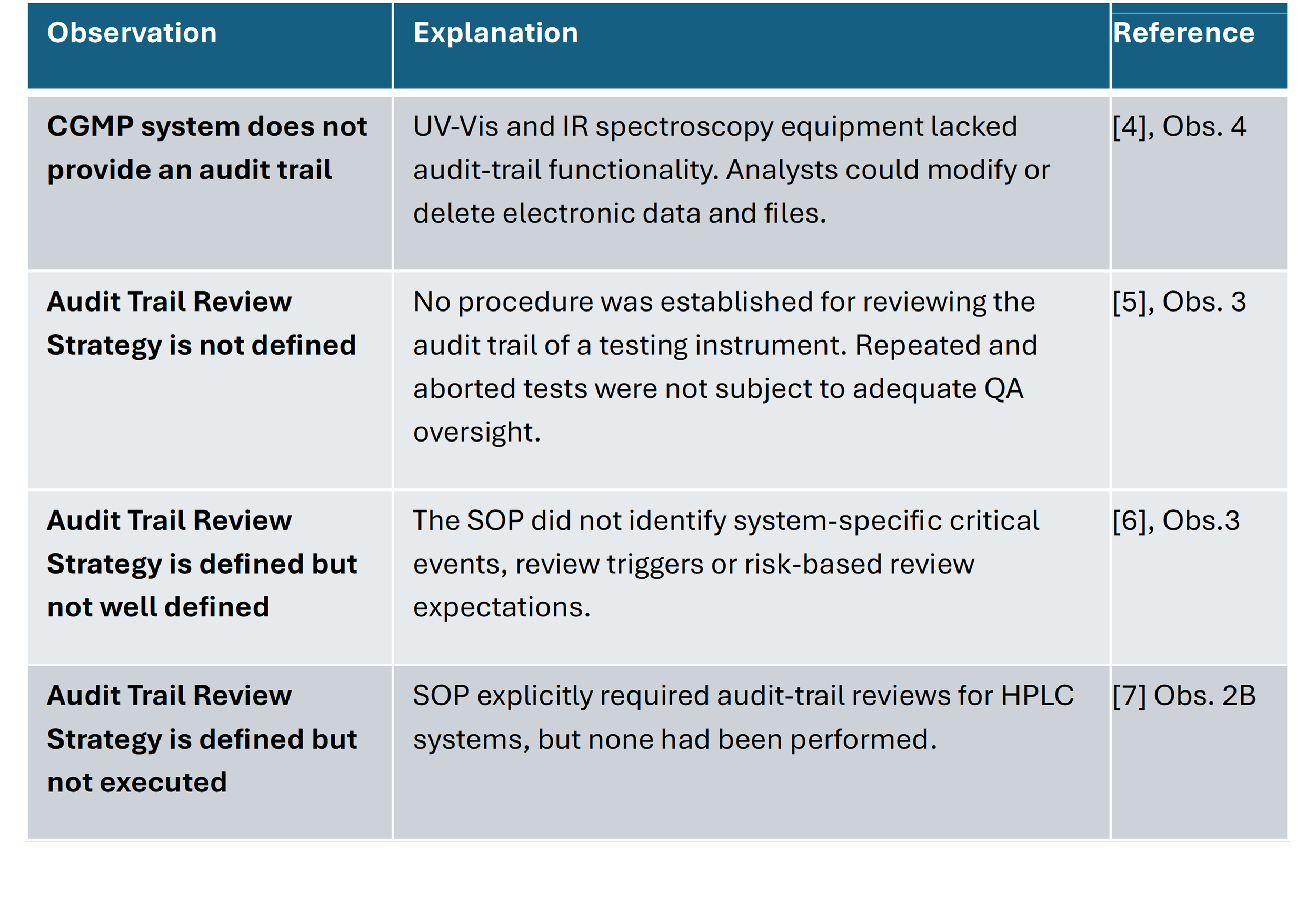
Table 1: Examples for typical FDA Audit Trail and Audit Trail Review Findings
These findings demonstrate that having an audit trail is not enough. An effective Audit Trail Review strategy requires three levels of control:
Level 1: Establish the Prerequisites
Before reviewing audit trails, we need to ensure that the underlying systems provide reliable records.
This includes:
Technical controls: Reliable timestamps, individual user accounts and appropriate access controls.
Audit trail functionality: Relevant activities must be recorded and protected against unauthorized modification.
Usability: Audit trails should be searchable, filterable, backed up and retained throughout the required retention period.
System design matters enormously. An audit trail containing thousands of poorly structured entries can make meaningful reviews unnecessarily difficult.
Practical tip: Ask your system supplier for a complete list of events recorded in the audit trail. This is an excellent starting point for determining which events are critical.
You might be surprised how often suppliers struggle to provide this information!
Level 2: Define a Risk-Based Review Strategy
Having an audit trail is only the beginning. The next step is defining what to review, when, and by whom.
A generic procedure is rarely sufficient. Different systems generate different audit trails, and review requirements depend on the intended use and criticality of the data.
Importantly, audit trail reviews should be integrated into the review of operational data, rather than treated as an isolated compliance activity.
Two categories are particularly relevant:
Operational or Process Audit Trails
These document activities directly related to the GMP process, such as method selection, parameter changes, data corrections, processing or reprocessing.
Relevant entries should be reviewed alongside the associated process data, before the corresponding GMP decision is made, for example, before batch release.
Administrative or System Audit Trails
These capture activities such as changes to user permissions, system configuration and other administrative actions.
They are typically reviewed periodically, with the frequency and scope determined through Quality Risk Management. PDA Technical Report 84 provides useful examples.
The distinction helps establish a review strategy that is both meaningful and manageable.
Level 3: Execute and Improve the Strategy
Even the best review strategy is ineffective if it is not consistently executed.
Reviewers need clear instructions, appropriate training and sufficient time. Their feedback should also be used to improve the review process.
But there is another important opportunity: automation.
Humans are not particularly good at repeatedly reviewing large amounts of routine data. Where technically feasible, automated controls can provide more consistent and efficient oversight.
For example, instead of manually checking whether critical process parameters match an approved recipe, an MES could perform this verification automatically.
This enables a Review by Exception approach, allowing reviewers to focus on deviations, unusual activities and events requiring expert judgment.
Automation does not eliminate human responsibility—it allows human expertise to be used where it adds the most value.
Take-Home Message
An effective Audit Trail Review strategy is not about reviewing as many entries as possible.
It requires three things:
A reliable and usable audit trail
A system-specific, risk-based review strategy
Consistent execution, supported by automation where appropriate
The objective is not simply to demonstrate that audit trails have been reviewed. It is to ensure that GMP decisions are based on complete, reliable and trustworthy data.
Feel free to get in touch to discuss your current challenges. Let’s get started working together by scheduling a workshop for you and your team!
References
[1] FDA, Data Integrity and Compliance With Drug CGMP: Questions and Answers, Guidance for Industry (2018).
[2] PIC/S, PI 041 – Good Practices for Data Management and Integrity in Regulated GMP/GDP Environments.
[3] PDA, Technical Report No. 84: Integrating Data Integrity Requirements into Manufacturing & Packaging Operations (2020).
[4] FDA, Guangxi Yulin Pharmaceutical Group Co., Ltd., Warning Letter 710422 (30 September 2025). Link.
[5] FDA, Unither Manufacturing LLC, Form FDA 483 (15 May 2026). Link
[6] FDA, Lupin Limited, Form FDA 483 (17 July 2025). Link.
[7] FDA, Allure Labs, LLC, Form FDA 483 (27 March 2026). Link.
